Tuesday, June 26, 2007
This Changed My Life
This was the result of a dare I recieved Wednesday at our district high school camp last week.
Yes, I did both sides.
Yes, I can use deodorant, but only since last Saturday. Though, thanks to Tony Johnson, I'm going to try switching to women's deodorant for a while. It's designed for females who are hairless precisely because of these types of sado-masochistic practices and may be gentler. Plus, as he reminded me, it has a nice floral smell.
Yes, it burns when I sweat. So I try to stay out of situations where I would.
No, I don't regret it, though I probably won't ever do it again. Kinda like when I stuck my finger up my butt when I was three. It wasn't pleasant. But I learned a lot and am a different man now.

Monday, June 25, 2007
We're Talking About More Than Prayer Here

'Have You Prayed for bin Laden Today?'
Brother Andrew urges Christians not to "black list" radical Muslims.
Deann Alford
Brother Andrew, founder of the persecuted-church ministry Open Doors and author of the forthcoming book Secret Believers, has been traveling to the Middle East for more than 30 years. During that time, he has met with Israelis, Christians of all kinds, and Muslim leaders from Fatah, Hamas, and other radical or militant groups. Ever since his Cold War days taking Bibles behind the Iron Curtain (made famous in his 1967 autobiography, God's Smuggler), American Christians have often responded to Brother Andrew's reports with some degree of skepticism, but always with awe. Christianity Today senior writer Deann Alford recently interviewed Brother Andrew on the current Gaza crisis and Christian relations with fundamentalist Muslims.
What have you heard about the current situation inside Gaza?The situation is quiet at the moment. [The conflict] will continue, and one party will have full control. Gaza will not only be a prison camp, but also will become a concentration camp. It will become much worse, not because of the Islamist influence, but because of the repression from outside. The boycott and all the feelings that come from outside. That includes you and me, our nations, our governments.
What will a Hamas-controlled Gaza mean for Christians and everybody else?
It looks confusing. And yet, it is not. I talked to the Hamas leaders years ago about what they wanted. This is exactly what I see happening today. They follow a plan, and there's nothing wrong with having a plan. We also have a plan. We read the Bible. We have sort of a mental concept of what it's going to be, and Hamas has that, too. They have a very strong belief, and they act upon it, that in the end times in which we now live, they believe that Islam is going to conquer and rule the world. And what they see—in very concrete terms in Gaza and West Bank and the surrounding countries, across Jordan, Iraq, Iran, Afghanistan—is a pan-Arabic republic. No borders. No Jews. They say that literally. That's not antagonism. That's their faith dictating them to say so.
So I said to them, "There's no room for Christians. You're going to persecute us." They said, "No, Andrew, there will always be a place for Christians like you." So far, my own contact, and that of the Baptist leaders and that of the Bible shop leaders in Gaza has been very positive with Islamic Jihad and Hamas.
Their worldview is in relation to end times. That's why they're willing to die. It's more than statehood. They're not interested in a Palestinian state. They're thinking so much bigger. That's why they have such amazing support among the grassroots level of the people, because of their reputation for not being corrupt, which is absolutely true.
Why have there been so many suicide bombers in recent years?
I challenge the Hamas leaders about the suicide bombers, which I'm terribly, terribly opposed to. I've preached against it. I contended in the strongest terms when speaking with the Hamas leaders, and they said, "Brother Andrew, we agree with you. The Qur'an forbids suicide." I said, "What is it that I see all around me?" They said, "But that is religious." I said, "Of course, you make it a million times worse because now you have a million volunteers."
There's no way we can cope with or challenge that level of dedication. They believe in something, and they're going to die for it. We fight [Islamic ideology] with bombs and armies. We're doomed to lose that battle. We have to go back to the root causes. We have to listen, we have to understand, we have to talk, and then I think we can still make progress.
Speaking as a Christian, they are not our enemies. God loves the world. And in my new book, Secret Believers, we propose the question, "Have you prayed for bin Laden today?" That question should shock a lot of Christians. Of course we haven't! That is why he is what he is. We have an evangelical black list of people we don't want to see in heaven and put bin Laden on top. Saddam Hussein is probably second.
Do you see the Middle East becoming peaceful in the short term?
We are fighting a losing battle, we are sacrificing our young people, we ruin our economy, we spoil our reputation, and we make life impossible for the American dream of Western influence. I love America and Americans. I love our culture. But if God does not see anything in our culture that he wants to protect, we face this self-chosen conflict in which we will definitely go under. And that will be a great shock to us. It's not too late. I passionately plea for understanding of this kind of Islamism. It's the basic root of the problem.
Do you think policymakers in Washington understand Islam very well?
When the chief of staff in the White House a few years ago [Andrew Card] read our book Light Force, he said these guys are the only ones who really understand what is going on in the Middle East. And he said, "Andrew has to preach in the White House." Which I did last year. I spoke about the God of forgiveness as opposed to the God of revenge.
We in the West are following or believing in the God of revenge as much as every Muslim does. So there's no need for us to sit on a pedestal. We have to come down to the foot of the Cross and learn from Jesus. He came to forgive, and he came to die. I have seen this attitude in many Christians in Gaza. It gives me hope for the future.
In my 50 years of ministry, my biggest meetings have been always in the Muslim world, teaching at a university in Gaza, speaking to the medical association there. My biggest meetings with Hamas were with 400 men. Why are we so timid? Why are we so afraid? They barely let me speak at my own evangelical church in Holland! I'm being sarcastic, but it is the truth. I find it easier to get speaking engagements with the Taliban than with my own evangelical church.
Why should evangelicals stay the course and be engaged with the Arabic church in the Middle East?
What Muslims see when we talk about the church is a completely different picture, and it is not the first important point. The most important point is what they perceive of what we say and do. This is what they think of the West: They think every white person is a Christian, every soldier in uniform is a Christian, every bomb is a Christian bomb. Nobody ridicules that idea. When we read about nuclear plans, we always talk about the Muslim bomb. Why shouldn't they talk about the Christian bomb? You see my point?
It's terrific if individuals or local churches or small, effective evangelical missions (I know many and Open Doors is only one) are really engaged with the Arabic-speaking church.
Soon I will be back in Iran. I do that with fear and trembling. I represent Jesus. I represent the body of Christ, and that is not what they perceive of the church. That's not what [Muslims] hear the church say. They see a very one-sided support of Israel. This is foremost on their mind [and] the church that drops bombs on them from F-16s and Apache helicopters. That's what they see the church is doing. It's their mindset. I'm not saying it's right or wrong. This is what it is.
How can we now make an impact, first of all, to say I only represent Jesus Christ? Here is the message. This is his book. Then they listen. They have been taught to listen to and even study the Bible.
They have a holy reverence for the Bible as a book. Whenever I pull out the New Testament or the whole Bible, I can preach whatever I want. I preach very evangelistic sermons there. So here's the tricky part: If Brother Andrew can do it, I think everybody can do it. Because everybody is better than me, and everybody is more able and gifted and supported. I'm just one little Dutchman walking on wooden shoes. Let us do it as a church.
We should be flocking to Jordan, Lebanon, Syria, and seek the Christians and help them. And then, please, for God's sake, listen to what they say. They have something to say. This should be the driving force in our lives. It's not solving political or economic problems. It's being Christian.
My plea always has been that the church must be the Church, with capital letters.
In our new book, we have a whole chapter on a town in Pakistan that was destroyed by Muslims. We went over there and preached forgiveness openly to the people, to the government, to the military and the police. We had a tremendous time. Open Doors had a big community center, literacy school, training for Sunday school teachers and leaders. And the violence ceased because we officially said, "We forgive you Muslims because Jesus forgave us. And that's the reason of our existence. Jesus has forgiven us—not because we begged for it, but because he offered it."
That should be our attitude. That should permeate the politics of our nation.
What should Christians be doing right now?
Get up and get going for God. It's still not too late. I can still reach them. And I'm not the only one. We can reach the Taliban. We can reach Hezbollah. And I do, actually. I'm not a man with any authority or a mandate, just an individual Christian. I'm not altogether pessimistic. I'm saying at the moment as a church we're not on the right track and we ought to do something about it.
Look at the problem there with very different eyes. It's a religious problem, but it's not their fault that they have not heard who Jesus is. When we look at the history of Islam and other religions, it's always been where we've not done what we should have done, where we have not brought the gospel when we should have. We have not reached out in love and compassion. These things can still be done.
Get to know more facts. What is really happening? Is being radically right the answer? We're not sent to kill people. Nobody is, but certainly not Christians and missionaries.
If we can make the Muslims or al Qaeda our friends by political decision, then we've been killing them in vain. It's murder. So let's stop that. Let's find out the facts. Let's go with an open mind. Let's respect their religion. We've always been taught that way as Protestants.
You can still go to any place in the Muslim world and preach Christ. Any place. I want to challenge the whole world with that statement. And if that is true, then why are we resorting to other weapons that, according to the Bible, are not weapons of our warfare? When are we going to be people of the Book? They claim to be people of the book. I challenge them at the Hamas university on dialogue—and I hate the word dialogue—I'm a proclaimer, a Calvinist at heart. I believe that faith comes by hearing, and hearing by the Word of God. I told them openly, "I'm not interested in dialogue with you guys. But I'm always willing any place, any time, with any group of you, to have a dialogue on this one question: What kind of person does the book produce—your book, my Book?"
You come back to Jesus' words: You must be born again. And they appreciate that. Because I want to challenge them on that issue.
I'm an evangelist. I'm a missionary. If I'm saying things that are politically not correct, I know the Lord will forgive me.
What keeps you hopeful about this desperate situation?
We have a message that God changes people. We still have to go [to the Middle East]. Our philosophy is going. Going takes away your fear. We are fearful because we stay home and prepare for the worst to come, because we think that's what they are planning. That may be true, but it's because of our inactivity. The moment we take the offensive and plan to go there, we lose our fear. That's very Scriptural. I'm not a bit afraid of them. I feel completely at home. I hope to be back there very soon. If I knew I could do something constructive, I'd be there tomorrow.
Deann Alford is based in Austin, Texas, and reported for CT from Gaza in 2005.
Copyright © 2007 Christianity Today. Click for reprint information.
Friday, May 11, 2007
The Jason Borne of Christianity

It is pretty well agreed upon within our denomination that The Church of the Nazarene has lost its sense of identity.
As evidenced by Articles of Faith and the testimony of the founding fathers of our denomination, we are first and foremost a Christian Church, with the SECONDARY distinctive of offering a unique emphasis on the work of the Holy Spirit in entirely sanctifying believers.(1) Yet, as evidenced by the practices and theology (or lack of) of most local congregations we are simply, in the words of Rob Staples, "a generic evangelical" Church.
Many would argue that our identity crisis stems from our loss of the American Holiness understanding of entire sanctification as an instantaneous work wrought by the Holy Spirit subsequent to justification. Richard Taylor would be one of these. Others would say that our identity crisis comes from our lax ethical interpretations of what the life of an entirely sanctified believer should look like. My mother would be one of these.
However, I feel that our identity crisis comes from a deeper place, as evidenced by the fact that we cannot even agree on what is causing said crisis.
Mark Quanstrom does a great job of tracing the growth of divergent views on our "distinctive doctrine" in "A Century of Holiness Theology." I highly recommend this book, but I do not feel, as he seems to, that our biggest problem is our inability to agree unilaterally on how to understand and communicate the doctrine of entire sanctification. Neither do I think that what we need is an agreed upon set of rules that will form us into a unified body. I feel our greatest problem, that feeds our inability to agree on sanctification, is that we have gradually, as we tried to carve our place within the denominational marketplace, separated ourselves from the trunk (the catholic church) that gives life to our individual, distinctive branch (the Nazarene denomination).
To reclaim an identity that is not best described as a bland, generic, fundamentalist evangelicalism, we must first rediscover the depth of our Christian heritage. This goes back much further than Phineas F. Bresee, Phoebe Palmer, John Wesley and, yes, even Martin Luther. To truly see who we are in Christ as members of his Body, we have to see that who we are is bigger than a misguided response to theological and ethical liberalism, bigger than our pet economic theory, bigger than the Nation-State in which we live, bigger than a reaction to the abuses of power that the Roman Catholic Church was guilty of(2). We need to see that we are not the end, the climax of God's work on earth. We are instead the product of the faith of our fathers and mothers, and instead of jettisoning them to achieve our own short sighted goals we need to see our place as contributing to the long-term life of the church.
Yet, even this is not enough, is not an end in itself. Doing this will only be beneficial if it takes us from the trunk to our true root: love as understood by the life and actions of God. It is the love of God that led God to work in history through his Son to restore mankind to himself. It is this love that gave the Holy Spirit to continue this work in and through the lives of the disciples. This love is the same love that caused each generation of believers to shape new believers, and therefore to pass the Gospel on to us. It is this love that allowed us to become members of the church today. It is this love that sanctifies us as we participate in it, making it our own as we love God and neighbor.
And it is this same love that must be at the very core of our identity. Not a time line of sanctification. Not a list unacceptable entertainment and adornment. Without this love we are left to our own devices, which will lead us to nothing but nihilistic amnesia.
(1) Yes, this is a particular interpretation of the Articles of Faith, but it is also the way of interpreting that I later argue for as being critical to recovering a unified sense of identity.
As evidenced by Articles of Faith and the testimony of the founding fathers of our denomination, we are first and foremost a Christian Church, with the SECONDARY distinctive of offering a unique emphasis on the work of the Holy Spirit in entirely sanctifying believers.(1) Yet, as evidenced by the practices and theology (or lack of) of most local congregations we are simply, in the words of Rob Staples, "a generic evangelical" Church.
Many would argue that our identity crisis stems from our loss of the American Holiness understanding of entire sanctification as an instantaneous work wrought by the Holy Spirit subsequent to justification. Richard Taylor would be one of these. Others would say that our identity crisis comes from our lax ethical interpretations of what the life of an entirely sanctified believer should look like. My mother would be one of these.
However, I feel that our identity crisis comes from a deeper place, as evidenced by the fact that we cannot even agree on what is causing said crisis.
Mark Quanstrom does a great job of tracing the growth of divergent views on our "distinctive doctrine" in "A Century of Holiness Theology." I highly recommend this book, but I do not feel, as he seems to, that our biggest problem is our inability to agree unilaterally on how to understand and communicate the doctrine of entire sanctification. Neither do I think that what we need is an agreed upon set of rules that will form us into a unified body. I feel our greatest problem, that feeds our inability to agree on sanctification, is that we have gradually, as we tried to carve our place within the denominational marketplace, separated ourselves from the trunk (the catholic church) that gives life to our individual, distinctive branch (the Nazarene denomination).
To reclaim an identity that is not best described as a bland, generic, fundamentalist evangelicalism, we must first rediscover the depth of our Christian heritage. This goes back much further than Phineas F. Bresee, Phoebe Palmer, John Wesley and, yes, even Martin Luther. To truly see who we are in Christ as members of his Body, we have to see that who we are is bigger than a misguided response to theological and ethical liberalism, bigger than our pet economic theory, bigger than the Nation-State in which we live, bigger than a reaction to the abuses of power that the Roman Catholic Church was guilty of(2). We need to see that we are not the end, the climax of God's work on earth. We are instead the product of the faith of our fathers and mothers, and instead of jettisoning them to achieve our own short sighted goals we need to see our place as contributing to the long-term life of the church.
Yet, even this is not enough, is not an end in itself. Doing this will only be beneficial if it takes us from the trunk to our true root: love as understood by the life and actions of God. It is the love of God that led God to work in history through his Son to restore mankind to himself. It is this love that gave the Holy Spirit to continue this work in and through the lives of the disciples. This love is the same love that caused each generation of believers to shape new believers, and therefore to pass the Gospel on to us. It is this love that allowed us to become members of the church today. It is this love that sanctifies us as we participate in it, making it our own as we love God and neighbor.
And it is this same love that must be at the very core of our identity. Not a time line of sanctification. Not a list unacceptable entertainment and adornment. Without this love we are left to our own devices, which will lead us to nothing but nihilistic amnesia.
(1) Yes, this is a particular interpretation of the Articles of Faith, but it is also the way of interpreting that I later argue for as being critical to recovering a unified sense of identity.
(2) Yes, I said "was," not "is." No, I am not referring simply to the sales of indulgences and the carrying out of the crusades, I am aware of what has recently been exposed about the way that the Church covered up sexual abuse (see Amy Berg's documentary "Deliver Us From Evil" for a heartrending treatment of this misuse of power). I used the past-tense because 1. Though the crisis is far from over and much is left to be done for the victims, I believe the Church is repentant, and 2. I believe God forgives. Therefore she was guilty.
Thursday, May 03, 2007
Fundi History

Thanks to Jamie Smith there is an interesting lecture that has been made available here about the history and theology of the American Fundamentalist movement from the perspective of journalist Jeff Sharlet called "Fundamentalist History, Secular Myth, and the Media's God Problem." Good stuff. Let this "outsider" disturb us and help offer us a corrective...please God...
A word of caution though, I am not advocating buying completely into Sharlet's worldview and secularist theology...just listen, because I believe he can help us come to a more honest assessment of where Christianity is (and isn't) in America.
A word of caution though, I am not advocating buying completely into Sharlet's worldview and secularist theology...just listen, because I believe he can help us come to a more honest assessment of where Christianity is (and isn't) in America.
Thursday, April 26, 2007
Sharing (Isis) is Good
I just thought I'd share one of the best heavy experimental bands out there with you. They're called Isis (pronounced eye-sis, as in the Egyptian goddess and archetypal wife and mother) and will be well worth the eight minutes you put into the song.
This is definitely not a cheap quick trip like a 3:30 pop song with an intro, verse, chorus, verse, chorus, bridge, chorus, outro structure. Their songs fade in and out and wind all over, taking you somewhere you've probably never been before. Enjoy the journey. Bang your head.
Wednesday, March 14, 2007
Salvation Crisis?

It's no secret to any of you (pl?) out there who care enough to regularly check my blog that I have been quite lazy recently. This post does not change that. I ripped it off from Charlie, a truly faithful blogger. Nonetheless, it is good, and important for you to read (if you havn't already on Charlie's behest). It comes from David P. Gushee on the Christianity Today website.
"This article was first posted 3/06/2007 on ChristianityToday.com. Used by permission of Christianity Today International, Carol Stream, IL 60188."
Jesus and the Sinner’s PrayerWhat Jesus says doesn’t match what we usually say.
Is it permissible to reopen the question of salvation? If we do, how will Jesus' teachings stand up to our inherited traditions?These questions came to me acutely not long ago. I was getting ready to preach. As the worship leader was finishing the music set, he offered some unscripted theological reflections. He said something like: "The only thing required of us is to believe that Jesus' blood saves us. Nothing more. It's nothing but the blood of Jesus."
In my Baptist context, we've heard these thoughts a thousand times. The problem was that I had in my pocket a message in which Jesus himself had a very different answer to the question of salvation.
The Big QuestionIn reading through Luke, I had discovered that twice (10:25, 18:18) Jesus is asked, "What must I do to inherit eternal life?"
In the first passage, Jesus turns the question back on the lawyer who asks it. The lawyer replies with the Old Testament commands to love God with all your heart, soul, strength, and mind, and to love your neighbor as yourself (cf. Mt. 22:34-40). Jesus affirms his answer: "You have answered correctly; do this, and you will live." The lawyer then tries to narrow the meaning of neighbor. So Jesus tells the unforgettable parable of the compassionate Samaritan, who proved to be a neighbor to a bleeding roadside victim.
In Luke 18, Jesus responds to the same question, this time from the man we know as the rich young ruler, by quoting the second table of the Decalogue, forbidding adultery, murder, theft, and false witness, and mandating honor towards parents. His questioner says that he has kept these commandments, and Jesus proceeds to call on him to "sell all … and distribute to the poor." Jesus assures him, "You will have treasure in heaven; and come, follow me." The "extremely rich" ruler won't do this, and Jesus goes on to teach his disciples about how hard it is for the wealthy to enter the kingdom of God.
Trying to be an honest expositor of the texts in front of me, I told the chapel students that morning that on the two occasions in Luke when Jesus was asked about the criteria for admission to eternity, he offered a fourfold answer: love God with all that you are, love your neighbor (like the Samaritan loved his neighbor), do God's will by obeying his moral commands, and be willing, if he asks, to drop everything and leave it behind in order to follow him.
I concluded by suggesting that the contrast between how Jesus answers this question and how we usually do is stark and awfully inconvenient.
Getting RadicalIn my Baptist tradition, especially, we direct people to "invite Jesus into your heart as your personal Savior," an act undertaken using a formula called the "sinner's prayer." Or we simply say, "Believe in Jesus, and you will be saved."
But Jesus never taught easy believism. Whether he was telling the rich young ruler to sell all and follow him or telling a miracle-hungry crowd near Capernaum that to do the work of God was, yes, to believe on him (John 6:28-29), he called people to abandon their own agenda and trust him radically. Radical trust calls for both belief and action.
I suggest that we tend to confuse the beginning of the faith journey with its entirety. Yes, believe in Jesus—that's the first step. Yes, invite Jesus into your heart as your personal Savior. Then, empowered by God's grace, embark on the journey of discipleship, in which you seek to love God with every fiber of your being, to love your neighbor as yourself, to live out God's moral will, and to follow Jesus where he leads you, whatever the cost.
If Jesus is to be believed, inheriting eternal life involves a comprehensive divine assessment at every step along our journey, not just at its inception.
Mediocrity and hypocrisy characterize the lives of many avowed Christians, at least in part because of our default answer to the salvation question. Anyone can, and most Americans do, "believe" in Jesus rather than some alternative savior. Anyone can, and many Americans sometimes do, say a prayer asking Jesus to save them. But not many embark on a life fully devoted to the love of God, the love of neighbor, the moral practice of God's will, and radical, costly discipleship.
If it comes down to a choice between our habitual, ingrained ways of talking about salvation and what Jesus himself said when asked the question, I know what I must choose.
Saturday, January 27, 2007
These are "Important," not "Best," Because "Best" is not a Theological Category
Charlie Pardue tagged me to put up my list of most important books of theology published in the past 25 years.
This is the criteria:
Name three (or more) theological works from the last 25 years (1981-2006) that you consider important and worthy to be included on a list of the most important works of theology of that last 25 years (in no particular order).
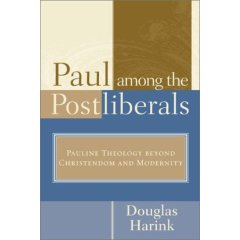
1. Paul Among the Postliberals by Douglas Harink 2003

2. Torture and Eucharist by William T. Cavanaugh 1998

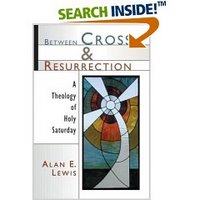
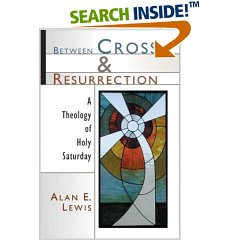
3. Between Cross & Resurrection by Alan E. Lewis 2001
This is the criteria:
Name three (or more) theological works from the last 25 years (1981-2006) that you consider important and worthy to be included on a list of the most important works of theology of that last 25 years (in no particular order).
1. Paul Among the Postliberals by Douglas Harink 2003
2. Torture and Eucharist by William T. Cavanaugh 1998

3. Between Cross & Resurrection by Alan E. Lewis 2001
Friday, December 29, 2006
Theology and History
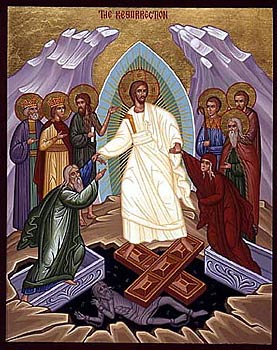
I've begun work on my masters. This includes reading, for a class titled Resurrection in the New Testament, N.T. Wright's historical look at the resurrection (both the actual event and the belief of the earliest Christians about the resurrection) called The Resurrection of the Son of God. (How many times can you say "resurrection" in one sentence?)
It has been argued by various theologians, and even some historians, that a historical look into the resurrection either cannot, or should not be done. One theologian, Hans Frei, (whom I happen to like, what little of his work I have gotten around to reading or reading about) falls in the "shouldn't be done" camp. He says that the resurrection is the starting point for any truly Christian epistemology, therefore nothing can be known about it without already knowing it. So the attempt of a Christian historical inquiry into the resurrection will collapse into itself.
Wright obviously disagrees to some extent. He does agree that the resurrection is at the base of any Christian epistemology, but argues that a historical study should be done because it could help one move from one epistemology to a better (more Christian) epistemology. He cites the apostle Thomas as an example. After seeing and touching the actual wounds on the body of the resurrected Jesus he believed.
On this issue I have a few thoughts/questions that I'm looking for some helpful discussion on. One: if we take embodiment seriously then a historical investigation into the resurrection should not prove harmful or fruitless, right? But, two: does such an inquiry, and even Wright's assertion that said inquiry can help move one from one (pagan) epistemology to another (Christian) epistemology, suppose a secular, or "neutral" realm that I have previously rejected thanks to John Wright and my reading in Radical Orthodoxy? (This is basically Frei's protest restated from a slightly different angle.)
From where I am in my thinking right now I don't think Wright's assertion necessarily does presume such a realm. It only does if we compartmentalize events and interpretation of said events. Since we cannot remove interpretation, we cannot remove faith, and only divinely delivered faith will lead to correct interpretations, even of a Christian historical inquiry into the resurrection.
Perhaps I have been guilty of completely disembodying faith. Yes, only faith can make the move from one epistemology to another, Christian epistemology happen. But perhaps God can and will use such a historical study to move one to a Christian worldview. Stated this way, the person would not be moved by unguided human reason but by God, making himself close, holding the spheres together with his presence moment by moment.
Do you agree? Or am I way off?
Monday, November 20, 2006

Wednesday, October 11, 2006
Voting As Christian Witness...

...is like discarding a half eaten hamburger in a trash can that happens to be in the vicinity of a homeless person and calling it a work of mercy.
I'm not saying that Christians should not vote. It is a responsible action. Like putting your garbage in a proper receptacle and not dropping it on the sidewalk. But lets call it what it is; and it is not letting the voice of the Church be heard. It is waste management. At best - and it rarely is - the state helps to restrain evil. It does not usher in the kingdom.
Neither party nor any recent candidate embodies the Christian message (No, not even Katherine Harris). Therefore voting = compromise. Picking the lesser of two evils. And witness and compromise are mutually exclusive concepts.
If we care about abortion do we simply vote pro-life then go home and watch TV and eat cheetos and feel good about doing our Christian duty? Dear God I hope not. Because where does that candidate stand on immigration? Helping those living in poverty? Inflation and debt?
I once talked with gentleman who said, "Yea. I may not agree with (a certain politician's) economic stance. But I made a decision long ago to vote strictly by moral issues, not economic theories."
Every issue is a moral issue.
Last I checked God loves Mexicans and poor people too.
"Oh, Wil. You can't have it all."
"Nope. Not within the American political system."
The lesser of two evils may be the better choice between two options. So go ahead and vote that way. But lets quit stopping there. The problem is that we've bought into the idea that these are the only options: liberal or conservative, yes on prop 204 or no on prop 204, legislated morality or ganja fueled peace orgies, elephants bearing their Americanized Jesus that feeds his cherished corporations with the corpses of the poor and then offers them a clear glass of melted glacier water to wash it down, or jackasses herded by Satan himself on a black ATV that runs on an alternative fuel derived from aborted babies and toppled monuments to the 10 commandments.
We've been told to "vote or shut up." If we believe this, if we see voting as our only, or even our primary, voice, then our ballots become the duct tape sealing our lips.
Thank the Living Jesus there is a third option: seeing the Church of Jesus Christ as the primary political entity to which we belong and through which we let our voice be heard. We do not need to continue searching and waiting for the perfect candidate to represent Christianity. I have been told so many times over the past few months as the mid-term elections approach that if Christians do not go out and do our part and vote, then we will be powerless as we watch evil continue to spread throughout our once great nation. Again, sure, vote. But I believe that voting is neither our only, nor our best, avenue for influence.
What is? The body of believers united and mobilized, willing to risk everything, to love God by loving our neighbor.
Since when do we have to wait for laws and governments to change things? The early Church brought about change by getting themselves thrown to the lions by the ruling authorities. They did not need to try to get the state to work on their behalf because they saw themselves as the instruments of God for change. We need no mediator and no law to grant legitimacy or power (efficacy) to what we are called to do. We only need the God-given faith and discipline to actually do it.
Monday, September 25, 2006
Les Miserables Biblical Commentary

Even if you are not a big reader, the unabridged version of Les Miserables is worth three-fold every minute it takes to digest its 1,463 glorious pages. I give you the following short passage in support of this claim (and I know Charlie Pardue is with me on this one). Though it fits impeccably within the gigantic narrative, it also stands on its own.
...he (the bishop) had his own strange way of judging things. I suspect he acquired it from the Gospels.
In a salon one day he heard an account of a criminal case about to be tried. A miserable man - because of love for a woman and the child she had borne him - had been making counterfeit coins, his real money was gone. At that time counterfeiting was still punished by death. The woman was arrested for passing the first piece he had made. She was held prisoner, but there was no proof against her lover. She alone could testify against him, and lose him through her confession. She denied his guilt. They insisted, but she was obstinate in her denial. At that point, the king's state prosecutor devised a shrewd plan. He maintained that her lover was unfaithful and by means of fragments of letters skillfully put together succeeded in persuading the unfortunate woman that she had a rival and that the man had deceived her. Inflamed with jealousy, she denounced her lover, confessed everything and proved his guilt. He was to be tried in a few days, at Aix, with his accomplice and his conviction was certain. The story was told and retold, and everybody was delighted by the magistrate's cleverness. Bringing jealousy into play, he had truth to light by means of anger, and justice had sprung from revenge. The bishop listened to all this in silence. When it was finished he asked, "Where are this man and this woman to be tried?"
"At the Superior Court."
"And where is the king's prosecutor to be tried?"
Read up those of you carrying out this "war on terror."
Monday, September 04, 2006
Will Ferrell and the American Jesus
How does Will Ferrell get it and such a large portion of the Church not?
In Talladega Nights, Ferrell’s character, Ricky Bobby, refuses to pray to any Jesus other than the “dear Lord baby, infant, 8 pound 6 ounce” (etc.) Jesus. When his wife informs his that he doesn’t need to continually refer to Jesus as an infant because, “he did grow up you know,” Ricky counters, saying he will continue to pray to the infant Jesus. When someone else is praying they can pray to the teenage Jesus in the temple or the adult Jesus in a boat, the dying Jesus on the cross, or even the decaying Jesus in the tomb if they like, but he will only pray to baby Jesus in the manger. Why? Because that is the Jesus he likes best.
Again, I ask: how is it that Will Ferrell can see that Jesus has become nothing more than a personal preference, a consumer option, when so much of the Church continues to, simply and ignorantly, choose which Jesus to peddle when we want to best “reach the people in our target demographic,” and which Jesus to “serve,” or appeal to, when we want something. How is it that Ferrell, the same man who donned a g-string Speedo for his appearance on Late Night with Conan O’Brien, has fingered our deficient interpretations that allow us to make Jesus into whatever best suits our group or individual interests (as determined by ourselves, of course) in various contexts while we continue proof texting in attempt to justify our child-like yearning to get our way?
Are you a combative Republican? Jesus can be that (Matt. 10:34 + Mk. 12:17a). Humanistic Liberal? He can be that too (Luke 17:21 + Matt 7:1). Marxist dictator? Check (Matt. 6:19, in light of Acts 2, + Matt. 10 37-38). Dangerous nomadic criminal? Sure (Matt. 8:20 + Lk. 23:32-33). Hermetic hippie cannibal? Yup (Mk. 1:35 + Matt. 6:25-29 + Matt. 26:26b-28). Let's go nuts; Jesus can even be an entrepreneurial motorcycle aficionado if you want to do some serious scriptural gymnastics (I don’t, but some niche marketing mega churches do). So pray to whomever you like.
Do you not like the Jesus that makes you uncomfortable by calling you out of your old life and into a new one defined by discipleship? Well fine, he doesn’t have to be that anymore. He can now become our spiritual masseur who relieves the tension “other” Jesus’ create. All we have to do is pluck him out of our favorite point in the narrative and construct an entirely new Jesus by creatively re-imagining that newly isolated moment, like the young girl I recently read with during an after school program who dispensed with the book’s story altogether in favor or her own fairy-tales made up on the spot as inspired by the accompanying pictures.
The problem with all of these appropriations is that none of them take seriously the entire, eternal life of Christ. The full Jesus was much more radical and much more distinctive than any of our own creative constructions. That is why his disciples appropriated for themselves an original name that rendered all other appellations obsolete. That title never was and never will be Republican, Democrat, Liberal, Compassionate Conservative, Post-modern, Socialist, Progressive etcetera ad infinitum. No, those simply will not do. Only one will: Christian. And Christians pray to one God through Jesus Christ. All of him. Every last life redefining bit. Take all; withhold nothing.
In Talladega Nights, Ferrell’s character, Ricky Bobby, refuses to pray to any Jesus other than the “dear Lord baby, infant, 8 pound 6 ounce” (etc.) Jesus. When his wife informs his that he doesn’t need to continually refer to Jesus as an infant because, “he did grow up you know,” Ricky counters, saying he will continue to pray to the infant Jesus. When someone else is praying they can pray to the teenage Jesus in the temple or the adult Jesus in a boat, the dying Jesus on the cross, or even the decaying Jesus in the tomb if they like, but he will only pray to baby Jesus in the manger. Why? Because that is the Jesus he likes best.
Again, I ask: how is it that Will Ferrell can see that Jesus has become nothing more than a personal preference, a consumer option, when so much of the Church continues to, simply and ignorantly, choose which Jesus to peddle when we want to best “reach the people in our target demographic,” and which Jesus to “serve,” or appeal to, when we want something. How is it that Ferrell, the same man who donned a g-string Speedo for his appearance on Late Night with Conan O’Brien, has fingered our deficient interpretations that allow us to make Jesus into whatever best suits our group or individual interests (as determined by ourselves, of course) in various contexts while we continue proof texting in attempt to justify our child-like yearning to get our way?
Are you a combative Republican? Jesus can be that (Matt. 10:34 + Mk. 12:17a). Humanistic Liberal? He can be that too (Luke 17:21 + Matt 7:1). Marxist dictator? Check (Matt. 6:19, in light of Acts 2, + Matt. 10 37-38). Dangerous nomadic criminal? Sure (Matt. 8:20 + Lk. 23:32-33). Hermetic hippie cannibal? Yup (Mk. 1:35 + Matt. 6:25-29 + Matt. 26:26b-28). Let's go nuts; Jesus can even be an entrepreneurial motorcycle aficionado if you want to do some serious scriptural gymnastics (I don’t, but some niche marketing mega churches do). So pray to whomever you like.
Do you not like the Jesus that makes you uncomfortable by calling you out of your old life and into a new one defined by discipleship? Well fine, he doesn’t have to be that anymore. He can now become our spiritual masseur who relieves the tension “other” Jesus’ create. All we have to do is pluck him out of our favorite point in the narrative and construct an entirely new Jesus by creatively re-imagining that newly isolated moment, like the young girl I recently read with during an after school program who dispensed with the book’s story altogether in favor or her own fairy-tales made up on the spot as inspired by the accompanying pictures.
The problem with all of these appropriations is that none of them take seriously the entire, eternal life of Christ. The full Jesus was much more radical and much more distinctive than any of our own creative constructions. That is why his disciples appropriated for themselves an original name that rendered all other appellations obsolete. That title never was and never will be Republican, Democrat, Liberal, Compassionate Conservative, Post-modern, Socialist, Progressive etcetera ad infinitum. No, those simply will not do. Only one will: Christian. And Christians pray to one God through Jesus Christ. All of him. Every last life redefining bit. Take all; withhold nothing.
Thursday, August 17, 2006
All Apologies

Sorry I've been away from my blog for so long. It's just that I've been a bit busy getting married and starting a family.
Once again, I apologize.
Saturday, July 08, 2006
Homily

A few weeks ago I traveled to Port Aransas, Texas, to officiate my first wedding. It was special and strange for me, being that it was my cousin Cheryl's wedding. And even though I am now 25 and she is in her early 30's, in some way she will always be my cool, pretty, older, teenage cousin. The one that used to let me tag along with her and her friends, feeling cool because of my proximity to cool people, sitting in the backseat of her mother's Suburban, with my little can that was supposed to resemble a snuff can full of stuff that was supposed to resemble snuff, but was really only ground up beef jerky, caring nothing about where we were going or what we were actually doing (usually nowhere and nothing). And the one with whom, when it was just the two of us, I could talk about George Strait and Guns 'N Roses in the same sentence. To most of my family that was sacrilegious. But we understood.
Add to this the fact that I myself will be getting married on July 15. So when the time came in the ceremony for me to give my very first wedding homily, I spoke to myself and my fiance as much as I did to Cheryl and Gary, and the whole experience became nearly surreal.
That is the backstory, as well as bits from my introduction. The following is body of the message I spoke.
...That is why we are here. To take part in something truly real. Often we pour our lives into chasing something we think will be real and lasting: wealth, security, prominence. Only to be disappointed when we finally grasp what we've been pursuing, open our hands to behold it, and see that it has disintegrated into dust, as everything that is at the mercy of time will eventually do.
But marriage is not like this, even though you both will die. As you look around today and remember the family members who are not here because they have already passed on, know that one day you too will join them. Even though thinking of yourself as one passing through death seems like something you read about in a science-fiction novel, something you may be able to imagine but you never fully believe that someday you will actually experience it, in due course, you will. But regardless of the temporal nature of your lives and marriage, as you live faithfully in this marriage, it will direct you to something eternal.
Because marriage is not about property rights. It is not about human law, because as necessary as human law may be, it does not have the authority to unite two lives into one. Only God has the authority to do this. And neither is marriage an outward sign of something you have already made real within yourselves. This is not a mere formality. If you surrender to and look for God in your marriage it will be what God intended and your marriage will actually strengthen and sustain your love. Not the other way around.
This sounds weird to many today who make no place for God in their interpretation of marriage. And I can understand this. It used to be a strange thought for me too. I used to think that it was the job of the human heart to sustain a marriage. And this is true to a certain extent; hearts are a necessary element of a faithful marriage. But hearts are fickle and unreliable. But God is not.
See, Gary and Cheryl, God has given you freedom and the ability to choose. And you have employed this gift to choose to commit to each other in love.
God has also given you the ability to love and the capacity to experience it.
But you and I do not create love. It does not matter what some poets or philosophers say, love is not manufactured in the human heart. God is the author of love. And this true love is the most beautiful thing we can know and experience. It brings a new dimension to every aspect of life because God himself is love. It is God's defining characteristic (I John 4:7-8).
Since God is love, we can only know true love as we know God. Without God our experience and understanding of love will always be less than it could be. And if we truly love, we are participating in God himself.
This is what is happening today. Gary and Cheryl, today you are asking for and accepting God's gift of love to the fullest extent that two people can know it between themselves. In a bit we will talk about nasty little things like sickness and poverty. In these times human love would throw in the towel. It would find it easier to (attempt to) sever the ties, (attempt to) heal, and (attempt to) go it alone. But divine love would not only persevere, but grow stronger through these times (I Corinthians 13).
Gary and Cheryl, love as you have known it thus far has brought you to this point. And this is good. It is as it should be. But today, you step a great deal further. You take a step that you could not take without divine aid. Today you are asking God to unite (mystically, but quite literally) you in love.
This act, in this place, is the divine intersecting the human. This is why certain sectors of the Church have considered marriage a sacrament. As God unites you, God will give you a bit of himself.
This is what marriage is about. Marriage is not about property rights. It is not about human law. This is something real. This is something permanent. This is something beautiful.
Monday, May 22, 2006
National Championships

My fiance, Amy Nanson (shown left, smacking the crap out of the ball), is currently playing in the NAIA national championship tournament (and kicking massive amounts of butt) along with the rest of the Point Loma Sea Lions. I am very proud of her. If you're interested you can follow the results here or even watch a live online play-by-play here (just click on the scores to the right of the game you are interested in - no video, sorry).
Wednesday, May 17, 2006
I Love This Man
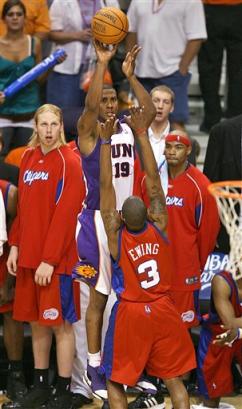
Chomsky may be right, professional sports may be the biggest single distraction that keeps people (especially Americans) from educating themselves and forming opinions about more important matters...but still, especially after last night, I love Raja Bell. And I will watch as many more 3 1/2 hour playoff games as the suns want to throw at me.
And just for good measure...

Peace.
Tuesday, May 16, 2006
A Credo On Pain

I believe in Beauty and Grace,
So I believe in Pain(1).
Because I believe these can be Painful(1),
Because I also believe in pain(0).
And this is hideous and graceless.
Though I have lived them both,
The distinction comes not from
how I experienced or interpreted,
But from the source and the end.
Whether I acted alone, was acted upon,
Was shaped, or further malformed.
Tuesday, April 11, 2006
Who Fits Who Into What Now?
 I did some kids' homework for them today. One of my co-workers has two children, a daughter who is 11 and a son who is 12, who go to a Lutheran school. Recently I have been entertained/troubled by some of her school stories. Especially one, that is so ironic it's ridiculous, about her son being accused of plagiarizing a poem he wrote on trust. Her disapproving letter to the teacher and principal that soon followed has led to some serious tension. Then, today, she informed me that her students had to finish a major science project by writing a conclusion that explains "how God fits into their findings." I offered my political pastoral skills, telling her that I could smooth things over for her, even the plagiarism issue, if she would let me do her kids assignment, squeezing God into their project somehow. The following is what I gave her. She says she's going to turn it in.
Of course God has something to do with all of this. God is the Creator of all things right? The phenomena I have observed in my experiments would not have happened if God had not established and sustained the created order. The very elements themselves would cease to even exist if God stopped graciously granting them existence. Be they a block of wood or a grain of salt, they only are because God allows them to be. Furthermore, I believe, no, correction, I know it to be true that neither I, nor you, nor any scientist with multiple doctorate degrees, is capable of properly interpreting these observations I have noted if they do not understand everything involved not as autonomous entities, but as created realities. They (not even the afore mentioned grain of salt) do not exist in and of themselves as a part of some independent secular realm evacuated by God. They only truly exist as they participate in their Creator.
What we really have here is a question of ontology. And I believe that a faulty ontology is the groundwork for the requiring of these paragraphs as a part of this assignment. An ontology that finds its roots in Scotus and Descartes, not in God. In the human mind alone, not in the true Faith that illuminates the human mind.
This ontology has caused you to fear the very science you love. You are afraid that science, if it continues unchecked in the apostate direction it has been heading, will succeed in pushing the God you love into a sphere of primitive susperstition. And this assignment is the best you can come up with to keep the younger generations from sacrificing the Faith on the altar of science.
You probably do not know where this is coming from. You might find these accusations unfounded. Well, here is my foundation: Your underlying ontology is betrayed in your instructions. You said, "Then, in a few short paragraphs, explain how God fits into your findings," instead of saying, "Then, in a few short paragraphs, explain how your findings fit into God." Who can compress God and fit the Creator of the universe into anything? If this is my assignment, I admit defeat.
Reason and faith are not mutually exclusive. Therefore I do not buy into the system, so prevalent even within "conservative" Protestant circles, that allows science as pursued as a secular endeavor to dictate what is real and true and then attempts to corroborate faith with science's findings. This inevitably leads to fundamental shifts that morph true Christianity into a sad (though all too convincing) parody. Of course God has something to do with my science experiment. God has everything to do with it. God has everything to do with everything. My question for you, and I am sure there is a good answer somewhere, is: "What does my science project have to do with God?"
She's checking out a pretty decent charter school.
Friday, March 31, 2006
Five Albums To Listen To In The Dark
Do This! And when you have to time to give the whole album a hearing.
1) John Coltrane - A Love Supreme. Careful, or it might usher you into a form of worship.
2) Meshuggah - I (EP). Just don't call me if you suffer ensuing night terrors.
3) Wilco - Yankee Hotel Foxtrot. It might take you deep enough to learn something about yourself.
4) Radiohead - Kid A. Ever wish you were somewhere else? Perhaps a paranoid "safety" bunker with your family during war time? I hope not. But it would probably do us a lot of good if more people felt at least a little of what it must be like.
5) Melvins - King Buzzo (EP). Let the repetition drive you insane (in a good way) as you begin to hear things you missed the first 60 times the drum riff assulted you... and then wonder if what you hear is really there. Plus there is a nice suprise guest on the last track.
1) John Coltrane - A Love Supreme. Careful, or it might usher you into a form of worship.
2) Meshuggah - I (EP). Just don't call me if you suffer ensuing night terrors.
3) Wilco - Yankee Hotel Foxtrot. It might take you deep enough to learn something about yourself.
4) Radiohead - Kid A. Ever wish you were somewhere else? Perhaps a paranoid "safety" bunker with your family during war time? I hope not. But it would probably do us a lot of good if more people felt at least a little of what it must be like.
5) Melvins - King Buzzo (EP). Let the repetition drive you insane (in a good way) as you begin to hear things you missed the first 60 times the drum riff assulted you... and then wonder if what you hear is really there. Plus there is a nice suprise guest on the last track.
Thursday, March 02, 2006
Remember That You Are Dust, And To Dust You Shall Return

Last night I presided over the first Ash Wednesday service my church has ever done. It was quite a humbling experience; throughout the whole service my sins were exposed. Not just brought to mind, but exposed. Like the way the first sentence of this blog exposes the arrogance that motivated it (I wanted you all to know, or at least sense, that I was the one who proposed and pushed for the observance of Ash Wednesday. To know that I know my Christian Tradition). Last night I was repeatedly shown ways that, as a minister, I attempt1 to take the work of the Holy Spirit into my own hands and desire, at least some, recognition. My posture, tone of voice, and thoughts (though internal, they are not private; thus in and through them God exposed my sinfulness) all betrayed my pride. Maybe not to all, but it really does not change my soul's standing before God if my students or volunteer staff are fooled.
It must sound strange for a sanctified Nazarene pastor to be talking about his sin. But it should not be. Truthfully, I believe that when we are sanctified, or, as we are being sanctified2, confession becomes more and more a part of our lives. This is because as we mature in the faith our sin tends to become less visible. So we do not outgrow confession, but learn more and more how central it is to our sanctification. God uses it to draw deeper, more subtle, and more fundamental sin out of the shadowy recesses and into the purifying light. It is grace, by this means like a beautiful puss that pushes the splinter to the surface so that it can be shown for what it is and extracted.
Last night will stick with me. It was one of those moments that was consumed by what is real. There is nothing false about a convicted sinner, who often sins because he forgets how short and precious life truly is and from whence it comes, with ash on his forehead, marking his fellow penitents (one of whom happened to be his sister) with the cross and urging them to "remember that you are dust, and to dust you shall return." So it will not fade into the past but will always be present as I move into the future.
1I originally typed this word in the past tense. I guess my purification was not completed at the close of last night's service.
2They are the same thing. So really, this sentence is redundant. I emphasized the "are being" because that is part we Nazarenes tend to overlook or de-emphasize in our own spiritual journey.
Subscribe to:
Posts (Atom)